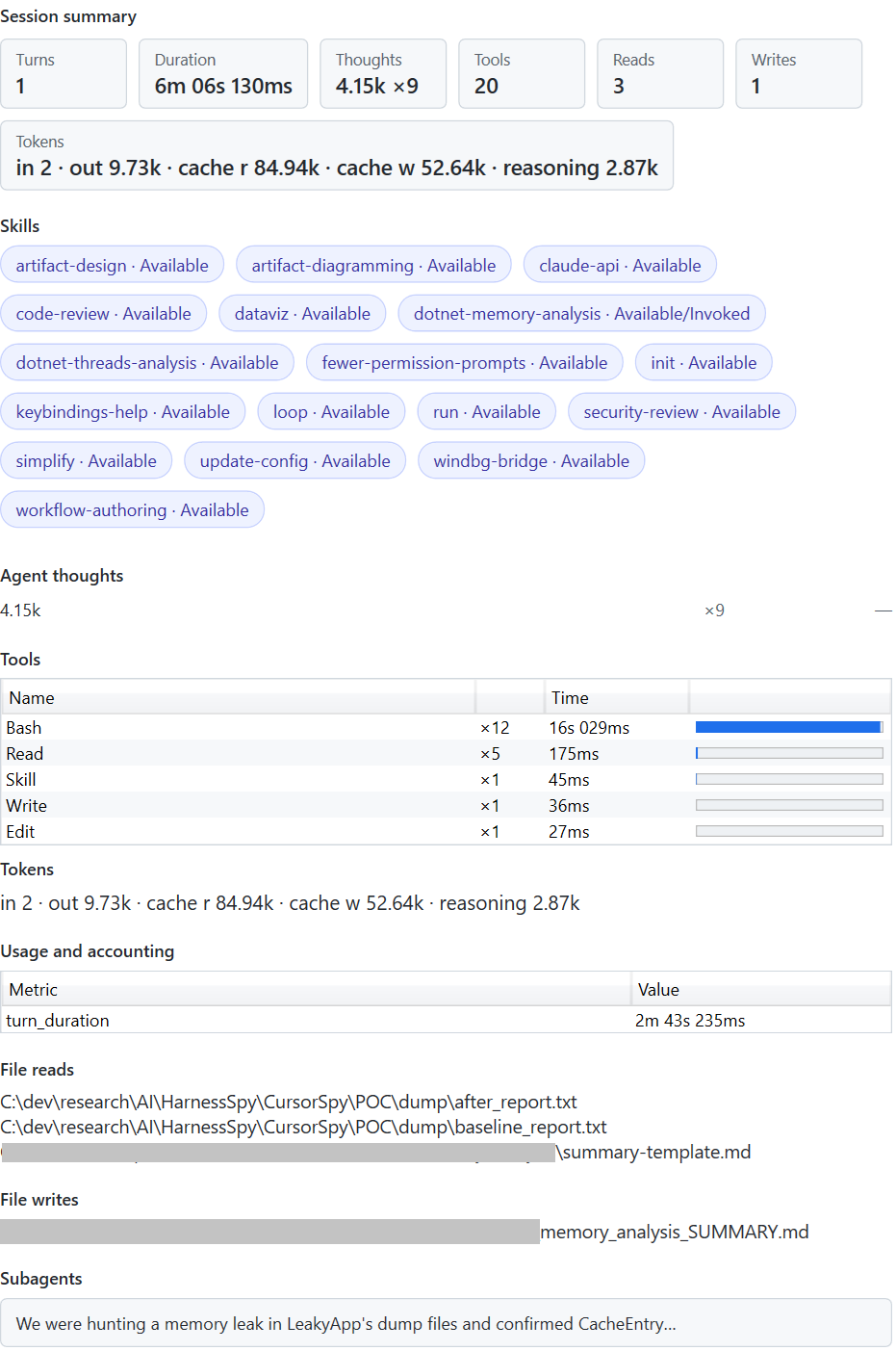
The first post of this series captured Cursor’s hook payloads. The second one reconstructed them into sessions, turns, tools, MCP calls, skills and summaries.
At that point, adding Claude Code looked straightforward: register its hooks, translate a few PascalCase event names and feed everything into the same tree.
Of course, it was not that simple.
Claude exposes some information that I would love to have in Cursor—loaded instructions, permission requests and denials, complete tool batches, and more context compaction details. At the same time, it removes some of the most useful Cursor details: there is no hook for visible thoughts, no dedicated Shell or MCP execution pair, and no token accounting. Even when both harnesses describe the same operation, their identifiers and event ordering are not always the same.
This is the third post in a multi-part series:
- Spying on Cursor: agent hooks, payloads and a simple observer
- Rebuilding the Agent conversation: sessions, turns, thoughts, tools, MCP, skills and summaries
- Spying on Claude Code: more lifecycle events, different blind spots (this post)
- Spying on GitHub Copilot twice: CLI hooks versus VS Code
- Beyond hooks: mining undocumented agent transcript logs
Claude reuses the same architecture introduced in the first two posts: one short-lived console hook forwards observations to the long-lived WPF viewer. I will not repeat the stdin, named-pipe and envelope mechanics here.
Claude is not Cursor with PascalCase
The first design decision was to preserve Claude’s native identity.
PreToolUse remains PreToolUse; it is not renamed to Cursor’s preToolUse. Bash remains Bash; it is not displayed as Shell. The same applies to Edit, Agent, PostCompact and every future event that HarnessSpy does not know yet.
The runtime engine still derives semantic traits beside the native payload:
- event role: prompt, tool request, permission, compaction, and so on;
- direction: input or output;
- scope: session, turn, tool call or subagent;
- tool kind: shell, file, MCP, agent.
The WPF tree and summaries use those traits, while the inspector always keeps the original event and field names. This avoids a tempting but dangerous shortcut: forcing every harness into Cursor’s vocabulary and silently losing provider-specific meaning.
Twenty-eight safe events, thirty-two when I really mean it
The current Claude hooks reference is considerably broader than the event set I started with. HarnessSpy’s catalog now contains 31 documented events plus PreModelSwitch and PostModelSwitch, whose payload schemas were still guessed at the time of writing.
For performance reasons, I did not want the default observer to subscribe blindly to every hooks, so the hook executable can generate two profiles:
| |
The generated file contains Claude’s nested settings.json hook structure, a five-second timeout and explicit HarnessSpy identity:
| |
The Safe profile registers 28 high-signal events. The Full profile adds:
MessageDisplay,FileChanged,Elicitation,ElicitationResult.
These four can be high-volume or expose sensitive user/tool interactions, so enabling them should be a conscious decision.
Both profiles deliberately exclude WorktreeCreate. That hook is not observational: its command must return the path of the worktree Claude should use. A passive hook that returns nothing would replace normal worktree creation without providing an alternative. This is exactly the kind of action a passive observer such as HarnessSpy must avoid.
For an isolated run, the generated profile can be easily added with the following command line:
| |
Silence is the no-op response for Claude hooks
Cursor and Copilot expect the passive hook listener to write {} as a no-op answer. Claude’s is different: ClaudeSpy.Hook writes nothing to stdout and exits with code 0. This small difference matters because stdout is still a control channel. A Claude hook can make permission decisions, add context or affect the loop depending on the event. HarnessSpy observes PermissionRequest, for example, but never answers it.
Generated environment variables in the hooks definition also solve a practical problem. Cursor and Copilot can import repository-level Claude settings. Without explicit harness identity, the same hook binary could be invoked by a foreign harness whose payload happens to use similar fields.HARNESS_SPY_RUNTIME_ID=claude-code is therefore used to uniquely identify the source. Payload clues such as prompt_id, permission_mode, or effort are only fallbacks. Casing alone is not enough to make the difference.
Four native identifiers make a strong skeleton
Claude provides four useful keys:
| Scope | Claude payload field | What HarnessSpy uses it for |
|---|---|---|
| Session | session_id | Group the complete conversation |
| Turn | prompt_id | Group events triggered by one user prompt |
| Tool | tool_use_id | Pair Pre/Post/Failure/Denied events |
| Subagent | agent_id | Pair SubagentStart and SubagentStop except that subagent start are never received as identified in this issue |
prompt_id requires Claude Code 2.1.196 or later in the current HarnessSpy contract. Older captures can still be displayed, but Claude has no Copilot-style derived-turn fallback: events without prompt_id remain at session level instead of entering a turn node.
This is better than deriving turns from timestamps or prompt/stop boundaries. A basic tool call becomes:
| |
PostToolUseFailure and PermissionDenied also carry tool_use_id, so they can close the same request exactly.
There is one useful exception to strict input equality. Tools such as AskUserQuestion can echo the original tool_input.question in PostToolUse and add an tool_input.answers object. The tool_input is so no longer structurally identical, but the unique native tool_use_id remains the stronger matching identifier key.
Strong identifiers do not remove every heuristic, though.
What Claude adds to the picture
Instead of listing all 32 events, these are the ones that changed what I could get:
| Event | What it adds |
|---|---|
UserPromptExpansion | Slash-command expansion details such as command name and arguments |
InstructionsLoaded | Which CLAUDE.md/rules file loaded, its memory type, reason and globs |
PermissionRequest | Tool/input requesting approval and the suggested permission changes |
PermissionDenied | Which exact tool call was denied and why |
PostToolBatch | The complete list of calls after a parallel tool batch resolves |
Notification | User-visible notifications, including permission prompts |
TaskCreated / TaskCompleted | Teammate task subject, description, owner and team |
TeammateIdle | Which teammate became idle and in which team (not tested) |
PreCompact / PostCompact | Compaction evidence with resulting summary |
ConfigChange, CwdChanged, DirectoryAdded | Changes to the execution environment |
PreModelSwitch / PostModelSwitch | Model change (before/after) |
The PostCompact payload provides a compact_summary field that contains a **Setup / system context:** section with interesting . It shows the content of the used CLAUDE.md if any:
| |
This is followed by the working directory and the git branch. The end was more surprising because it shed some light on what the harness thinks it is doing:
| |
I really don’t know where these come from…
The user prompt is shown after**The single substantive user message:** . Then, you get the real summary after **My approach, chronologically:** with every details about what has been tried and why. This compaction process is not cheap and could last minutes and be expansive in terms of tokens:

Claude’s Stop also carries last_assistant_message, so HarnessSpy can show the final answer even without Cursor’s afterAgentResponse event. StopFailure separates API/runtime failures from ordinary tool failures.
Permission requests have no call ID
The first surprising hole appears in PermissionRequest: it identifies the tool and its input, but it does not carry tool_use_id.
HarnessSpy therefore looks among the unfinished PreToolUse nodes in the same turn and compares:
- exact native tool name,
- canonical
tool_input.
Only one best candidate is accepted. The permission node becomes a child without closing the tool call:
| |
The Notification remains a highlighted sibling. It tells me that Claude displayed a permission prompt, but it has no stable relationship ID proving that it belongs to a particular tool request.
This flow is more informative than Cursor’s hook set because it exposes the request and eventual denial. It still does not provide a complete, timestamped request/answer pair for the user’s interaction. The interval between PermissionRequest and PostToolUse is suggestive, not guaranteed approval-wait time.
PostToolBatch: an echo for calls grouping
Claude emits normal PostToolUse events and then a PostToolBatch after the parallel batch resolves.
For a batch containing one call, the batch event node appears under the existing PreToolUse node using its tool_use_id. It is an additional audit record, not a replacement for PostToolUse.
For several calls, no single tool should own the batch. HarnessSpy creates a batch node and moves every matching PreToolUse beneath it:
| |
This grouping can also absorb a parallel-wave node previously inferred from overlapping timestamps. The native batch is stronger evidence than the viewer’s time-based heuristic.
Compaction has a beginning, an end and a hidden helper
Cursor gives a rich preCompact payload but no corresponding completion event. Claude exposes both PreCompact and PostCompact.
There is no compaction ID, so HarnessSpy attaches PostCompact to the most recent open PreCompact in the turn:
| |
It is a chronological heuristic, not exact correlation.
Real captures revealed another event between them: a summarizing subagent can emit SubagentStop without a matching SubagentStart (remember this issue). Its agent_type is empty and its final assistant message appears inside its compact_summary field.
When that textual evidence matches, the orphan SubagentStop node is relocated under the matching PreCompact:
| |
This is a good example of the rule used throughout HarnessSpy: use provider IDs when available, then structural evidence, and only then carefully bounded heuristics.
MCP without a dedicated execution span
Cursor emits generic MCP tool hooks and specialized beforeMCPExecution/afterMCPExecution events. Claude only uses its normal tool lifecycle and the following naming convention mcp__<server>__<tool>:
| |
HarnessSpy retains that native name and extracts dstrings as the server. PreToolUse/PostToolUse are colored as MCP events and summarized separately from native tools such as Bash or Read.
For a tool batch, the whole node receives the MCP treatment only when every bundled call uses the mcp__<server>__<tool> pattern. A mixed native/MCP batch has no single category.
What Claude does not provide is the inner execution layer provided by Cursor:
| |
The generic tool duration is therefore the only hook timing available. There is no separate transport/execution span comparable to Cursor’s.
Instructions and skills
InstructionsLoaded is one of Claude’s most useful additions. It can tell me that a CLAUDE.md or rules file was loaded, with fields such as:
file_path,memory_type,load_reason,globs,trigger_file_path,parent_file_path.
That is better than guessing instructions use from a prompt. However, it does not automatically indicate a skill. The shared skill detector from the previous post still looks specifically for a path ending in SKILL.md and derives the skill ID from its parent folder. But it is useless for Claude: I never say any such a read.
Fortunately, skills are explicitly identified in (Pre/Post)ToolUse tool_name field as “Skill” and skill/args tool_input subfields:
| |
Notice that the arguments are already computed (i.e. not explicitly provided by the user) based on the user prompt.
Subagents: exact IDs, richer endings but…
SubagentStart and SubagentStop share agent_id, making their lifecycle exact inside the turn:
| |
Unfortunately, as already mentioned, there is a bug in Claude that swallow the start event so, most of the data we get are from the stop events. The stop hook payload can include:
agent_type, (empty most of the time)last_assistant_message, (interesting about what the agent was doing)background_tasks, (not empty when related toforkagent type)session_crons, (empty during my tests; probably available with different usages)agent_transcript_path.
That final transcript path is particularly valuable because Claude can remove subagent logs quickly. When the viewer is running with transcript ingestion enabled, its ingestion pipeline registers and copies the file immediately—but transcript discovery, tailing and reconciliation deserve their own post.
What disappears compared with Cursor
The differences are easier to understand side by side:
| Capability | Cursor hooks | Claude Code hooks |
|---|---|---|
| Native turn key | generation_id | prompt_id |
| Tool/subagent keys | tool_use_id, subagent_id | tool_use_id, agent_id |
| Visible reasoning hook | afterAgentThought | None |
| Final response | afterAgentResponse | Stop.last_assistant_message |
| Specialized Shell span | Before/after hooks | None; Bash Pre/Post only |
| Specialized MCP span | Before/after hooks + server | None; mcp__server__tool Pre/Post |
| Dedicated file/Tab hooks | Yes | No |
| Hook token/cache counters | Yes in observed Cursor payloads | None |
| Loaded-instruction event | No equivalent | InstructionsLoaded |
| Permission lifecycle | Indirect tool failure | Request + denial + notifications |
| Parallel batch event | Inferred from overlap | Native PostToolBatch |
| Compaction completion | No | PostCompact |
| Main transcript pointer | transcript_path, often late | transcript_path at SessionStart |
| Subagent transcript pointer | Not observed | agent_transcript_path |
Cursor gives finer execution spans and the visible reasoning narrative. Claude gives broader orchestration lifecycle and generally stronger explicit correlation for tools, subagents and turns.
Neither provides the assembled system prompt or complete provider request.
What reaches the summary
Claude uses the same summary model as Cursor but feeds it through provider-native traits:
- native tools remain grouped under names such as
Bash,ReadandEdit; mcp__server__toolcalls populate the MCP section rather than normal tools;- successful
ReadandEditcalls populate read/written-file lists; - subagent status and final text populate the subagent section;
PreCompactincrements the compaction count;- failures and denied calls remain visible in the tree.
The important missing row is related to tokens consumption. Claude hook observations explicitly report no token counters. Likewise, InstructionsLoaded is visible in the tree and inspector but is not promoted into the Skills section merely because it points at a CLAUDE.md file.
A small glimpse beyond hooks
Claude exposes transcript_path for the main session and agent_transcript_path for a completed subagent. Those JSONL files add evidence that hooks cannot provide:
- opaque thinking blocks and signatures,
- structured tool requests and results,
- token/usage records,
- subagent sidechain activity,
- metadata around attachments and cost state.
They are undocumented, version-dependent and short-lived. Discovering a path is only the first problem; reading a file while Claude writes or deletes it and binding its rows back to hook events are harder.
A forthcoming post will explain why HarnessSpy treats transcripts as a secondary enrichment source instead of replacing hooks with them.
What I still cannot claim
Claude’s larger event catalog still does not provide everything:
- there is no hook exposing Claude’s private chain-of-thought;
- transcript thinking can be opaque rather than plaintext;
InstructionsLoadeddoes not reveal the exact final system prompt or ordering after server-side assembly;- a permission request does not by itself reveal the complete user interaction;
- token usage is not available in hook summaries.
Conclusion
Claude Code changed my idea of what a useful hook surface looks like:
- Native IDs matter more than naming conventions.
prompt_id,tool_use_idandagent_idgive turns, tools and subagents a strong skeleton. - More events expose more orchestration, not necessarily more model internals. Permissions, instructions, batches and compaction become visible while reasoning and tokens disappear from hooks.
- Exact identifiers do not eliminate heuristics. Permission requests, compaction and summarizer relocation still require structural evidence.
The next post will turn to GitHub Copilot, where one provider exposes two different hook surfaces.
